This is a continuation of the case study about Women's Centre in Rufisque. This post attempts to figure out how the communities form and create informal economy that becomes the core of the improvement.
In Senegal there is a government supported women's movement known as GPF (Groupement de promotion féminine) that has helped women organize and improve their situation themselves especially in the rural area. Although GPF is a subject of politicization that often lacks resources and funding, most women's groups and activities have still emerged spontaneously without governmental or municipal involvement or support. Following classification of women groups according to their function is based on the study which Anne Rosenlew conducted in Rufisque collecting data roughly from 50 women's groups from 1994 to 1998.
–Tontine
Tontine is the most common and popular form of women's groups as bank loans are practically unavailable to women they have to establish their own savings and loan system. The only way married women can earn money for the family is informal small scale trade, which is the most common form of livelihood for women of all ages. The women belonging to a tontine hold regular meetings and saving certain sum of money among its members. The sum of money is given to one or several person depending the size of the group and according to a system of rotation established in advance. This allows women to purchase some more expensive products or services they might need.
–Mbootay
Mbootay means association, society or club in local language. In rural villages the mbootay was the reference group for women of similar age or "extended family". In Mbootays the same age women work together for both everyday and festive occasions and form strong life-long ties of friendship. This extended family then helps women with their or their family's important milestones suchs as weddings and funerals etc. Mbootay also serves as social security in situations of crisis and provides important psychological and material support for its members.
–Collective
Collective is a more modern and more formal variant of working together. Collectives are officially declared at the Dakar Chamber of Commerce. Their function is primarily to serve as purchasing collectives for women that are engaged in small scale trade. Members of a collective may often have various joint investment projects by owning together some cooking pans or other utilities etc. that they can rent out for special occasions held in the neighborhood. Collectives can specialize and invest for example in growing vegetables or raising sheep or making clothes. Women belonging to a collective often have a higher sosio-economic status than women in general and they also play usually an important social role in the community. Collectives ensure more stable income to their members than tontines. Collectives are directed by boards that are elected from among the members while tontines have usually only one leader each and the leader has all the responsibility of running the system.
It will be great if we could meet Anne Rosenlew and learn what the preconditions are for communities to emerge. We will try to reach her and, if possible, invite her to the final critique to share ideas.
Apr 27, 2010

Apr 26, 2010
Case study | Mith Samlanh
–Brief
 In order to increase Mith Samlanh’s sustainability and to provide former street youth more opportunities for their futures, Mith Samlanh runs a range of income generating activities. They include: training businesses where students from the Vocational Training Center gain experience in a real business environment; social businesses where parents are provided with income generation support so that they can send their children to school rather than to work in the streets. These activities are also income generation ventures with profits used to fund other projects and contribute to the purchase of Mith Samlanh’s main center. Mith Samlanh is able to fund 44 per cent of its own financial needs directly from the income from these business ventures.
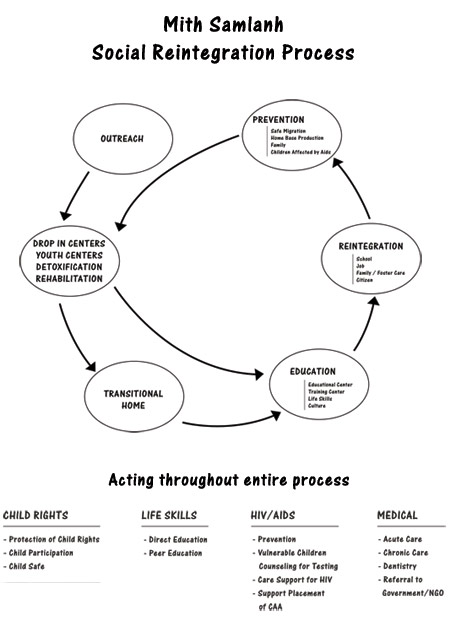
Mith Samlanh was established in August 1994 and is a non-religious, non-political organization working with street children in Phnom Penh and Kampong Cham. Working with street children, their families and their communities, Mith Samlanh’s projects are designed to assist the children’s social reintegration (reintegration into their families, the public school system, employment, and their culture).
Mith Samlanh has 217 staff (85 female) including social workers, teachers, trainers, doctors, house parents, cooks, cleaners and a small administrative team. Mith Samlanh was the first project established by Friends-International. In 1999, Mith Samlanh became a local Cambodian NGO, and is now run entirely by Cambodian staff. Friends-International continues to provide us with technical support and advice.
Mith Samlanh has 217 staff (85 female) including social workers, teachers, trainers, doctors, house parents, cooks, cleaners and a small administrative team. Mith Samlanh was the first project established by Friends-International. In 1999, Mith Samlanh became a local Cambodian NGO, and is now run entirely by Cambodian staff. Friends-International continues to provide us with technical support and advice.
–Background and challenges
Cambodia has a young demographic structure with 44.3% of the population under 18 years of age. A combination of severe decimation of the population during nearly three decades of war and civil conflict, a post-war boom and the low average life expectancy of 57 years, are reasons behind the unbalanced population demography.
According to official statistics, 35% of the population in Cambodia lives below the poverty line (1800 Riel / USD 0.45 per person, per day). Approximately 80% of the population lives in rural areas4 where the highest poverty and the lowest school attendance is found5. Crop failures, weather conditions, environmental degradation, health problems, landlessness and lack of access to land make families very vulnerable. Lack of opportunities such as poor access to assets, education and skills training, lack of infrastructure and inadequate farming technology are among the reasons behind poverty.
Though it is also widespread in high social classes, increased violence against women, rape, domestic violence and trafficking of women and children might be symptomatic of poverty. It may also be symptoms of a post-war stress reaction and for many the only solution to handle their stressful life.
In Phnom Penh there are, on a daily basis, 1,000-1,500 street children who have completely cut ties with their families and have made the streets their home. According to the figures accepted by UNICEF, there are between 10,000-20,000 street children working on the streets, who have kept ties with their families and return home either regularly or irregularly. Mith Samlanh estimates that there are between 500 and 1,500 children belonging to street living families. This figure fluctuates, depending on the situation in the provinces.
There are many reasons that children end up on the streets:
Poverty
Urban poverty forces many children to work. Either family poverty, or the need to supplement family income are the reasons most children work on the streets. The cost of public education (registration fees, uniforms, supplies, mandatory private lessons) is often too expensive for many parents, so they are unable to send their children to school. These children then spend most of their time unsupervised either loitering, or working in order to supplement the family’s income.
HIV/AIDS
Even though the adult HIV rate in Cambodia decreased from 3% in 1997 to 0.9 in 2006, the country still has one of the highest rates in Asia. As the number of children affected (sick parents, orphaned) is increasing, so is the number of street children. According to the Demographic and Health Survey 2005, 627,000 children are orphaned (62,000 double orphans) in Cambodia. No reliable statistics exist for those who have been orphaned by HIV/AIDS but might be as many as 60,000 orphans and vulnerable children in Cambodia due to HIV/AIDS. Many of these children will have to work to supplement their family income and will eventually have to fend for themselves.
Drugs
In recent years, drug use has become more common among youth from all social backgrounds. Drug use is rapidly forcing an increasing number of young people into poverty and on the street, putting them at risk of illness, violence, exploitation and other forms of abuse. There are an increasing number of children in the street due to drug use.
Migration
Poverty, lack of education, domestic violence and a lack of opportunities in the provinces have led to increased urban migration and an increase in the population of street living children, street working children and street living families. There are an increasing number of young migrants from provinces arriving in Phnom Penh, who are vulnerable to abuse and exploitation.
–Innovation & businesses
Students at Mith Samlanh range in ages from babies up to 24. Mith Samlanh is one of the few organisations that provides support to the 18 to 24 year age group. These children and youth come to Mith Samlanh for a variety of reasons, and Mith Samlanh does everything to try to reintegrate these young people back into society, into school, employment or back into their families.
For many young children, regaining their self esteem is a vital step in moving away from life on the streets. While at Mith Samlanh, they are encouraged to learn how to express themselves through art, sport and culture and interacting with other children.
Mith Samlanh outreach staff work on the streets to identify children and youth who could benefit from the services provided, but children are never forced to come to the center, or to stay there. It is entirely the decision of the children and young people to participate in activites, go to school or learn a trade at our center. It is this open door policy that is one of the reasons Mith Samlanh has a high success rate, of graduating students, children returning to families or coming clean from drugs.
 In order to increase Mith Samlanh’s sustainability and to provide former street youth more opportunities for their futures, Mith Samlanh runs a range of income generating activities. They include: training businesses where students from the Vocational Training Center gain experience in a real business environment; social businesses where parents are provided with income generation support so that they can send their children to school rather than to work in the streets. These activities are also income generation ventures with profits used to fund other projects and contribute to the purchase of Mith Samlanh’s main center. Mith Samlanh is able to fund 44 per cent of its own financial needs directly from the income from these business ventures.
As of May 2010, Mith Samlanh operates two training restaurants run by former street youth and their teachers. Mith Samlanh runs a 2nd hand store, Friends 'n' Stuff, and Tooit Tooit in Russian Market in which they sell products made by parents in the Home Based Production project, so that their children can go to school instead of working on the streets. The Nailbar offers manicures and pedicures and is run by the students in beauty training at Mith Samlanh/Friends. Last but not the least, the cookbook ‘Best of Friends’ sold in Mith Samlanh’s restaurants and shops also generates income for the organization.
What is great about Mith Samlanh is that 1. they have framework that formulate their operation in order 2. their various business will have the street children aquatinted with various future business opportunities as well as required skills. Students from Mith Samlanh may not have enough money to open a new business, but they will have skills, knowledge and most importantly dreams. We think Mith Samlanh's program will have bigger impact if they work with other organizations to create bigger coalition that help those experienced youth be entrepreneur.
Mithsamlanh. [http://www.mithsamlanh.org], retrieved May 5, 2010
Apr 25, 2010
Research | Cambodian Rural situation
According to the World Bank database, approximately 80 percent of Cambodia’s population lives in rural areas and 71 percent is primarily dependent on agriculture (largely rice) and livestocks for their livelihoods.
Poverty in Cambodia is overwhelmingly rural, with poverty head-counts ranging from a low of 10-15 percent in Phnom Penh to 40-45 percent in the rural areas, reaching 70-80 percent in some areas around the Tonle Basin. The poorest ones are particularly dependent on access to common property resources – fisheries and forestry – for example, eating and selling fish, eating mushrooms, and selling logs – so called “pickers”.
Agricultural growth had shown steady improvement, averaging 2 percent annually over the decade prior to 2005, when the sector had unusual high growth of 16 percent. However, agricultural production and general rural economic growth remain far below their potential because of low productivity, high vulnerability to weather, constrained access to land, forests, fisheries and markets, and lack of adequate infrastructure such as roads, water supply, electricity and communications networks.
Due to the large rural population and high potential for improvement, the government has highlighted promotion of agricultural development as the primary strategy for achieving higher growth and poverty reduction.
Although there have been impressive achievements, many challenges still remain to be addressed. The world Bank emphasize five key problems:
Poverty in Cambodia is overwhelmingly rural, with poverty head-counts ranging from a low of 10-15 percent in Phnom Penh to 40-45 percent in the rural areas, reaching 70-80 percent in some areas around the Tonle Basin. The poorest ones are particularly dependent on access to common property resources – fisheries and forestry – for example, eating and selling fish, eating mushrooms, and selling logs – so called “pickers”.
Agricultural growth had shown steady improvement, averaging 2 percent annually over the decade prior to 2005, when the sector had unusual high growth of 16 percent. However, agricultural production and general rural economic growth remain far below their potential because of low productivity, high vulnerability to weather, constrained access to land, forests, fisheries and markets, and lack of adequate infrastructure such as roads, water supply, electricity and communications networks.
Due to the large rural population and high potential for improvement, the government has highlighted promotion of agricultural development as the primary strategy for achieving higher growth and poverty reduction.
Although there have been impressive achievements, many challenges still remain to be addressed. The world Bank emphasize five key problems:
- Declining access to land, forests and fisheries due to appropriation by other interests – landlessness is estimated to be 20 percent in rural Cambodia
- Technology gaps compared to neighboring countries in production, transport, storage, processing and marketing
- Limited, long-term agribusiness investment due to a weak investment climate. – There are needs for better businesses, taxation, regulations to facilitate trade and improvements in the legal system governing contractual and property rights.
- Inadequate public services on agriculture – research, extension, market information and phytosanitary services
- Little development of production and marketing organizations
- Improving the climate for private sector investment – particularly trade facilitation.
- Strengthening public service delivery – particularly through public financial management and seeking opportunities to support public administration reform.
- Increasing the access of local communities to natural resources and their participation in management – particularly for land and forest resources.
- Supporting greater social accountability – particularly through supporting and strengthening the activities of local government and civil society
According to some internal sources, however, more than 2/3 will be lost during the process due to corruption. We ponder the opportunity price of the fund noting that it might only make the gap between the haves and the have-nots greater and greater.
–Reference
–Reference
World Bank. [http://web.worldbank.org/WBSITE/EXTERNAL/COUNTRIES/EASTASIAPACIFICEXT/CAMBODIAEXTN/0,,menuPK:293861~pagePK:141159~piPK:141110~theSitePK:293856,00.html], retrieved Apr 24, 2010.
Apr 24, 2010
Research | Brief history of education in Cambodia - Legacy of the Khmer Rougue
To understand the current situation of Cambodian education, we have to look at the history. Since at least the thirteenth century the traditional education system was centered on local temples and involved teaching students about the foundations of religion, basic literacy, and skills that were relevant to the rural life of most Cambodians.
In colonial times, though the French authorities did not pursue the modern education system with any great enthusiasm, the traditional education was gradually replaced by this modern Westernized educational model. The French seemed reluctant to devote the educational resources that were needed to meet local demand. The colonial era introduced to Cambodians the idea that education could lead to upward social mobility. It was a realization that led to unprecedented demand for access to education in the years that immediately followed independence.
Contrary to popular perceptions the postindependence education system was characterized by chronic crisis. Policies focused on getting as many students as possible enrolled at all levels of the education system were often unaffordable, and were concentrated on the very small modern sector of the economy (to the detriment of rural needs).
In 1970, with the outbreak of civil war, Cambodia's educational problems went from bad to worse. Many schools were leveled by bombs and teachers fled their posts joining the army. The victory of the Khmer Rouge only compounded the destruction. Classrooms were abandoned, books were left to rot, and former schoolteachers and higher-education students were singled out for execution. The education system was effectively ruined.
New regime that succeeded the Khmer Rouge was staffed by its survivors. Confronted with unparalleled destruction, it valiantly struggled to overcome educational chaos. By the end of the 1980s, educational enrollment levels especially in primary schools had largely overcome the legacy of the Khmer Rouge period. Marked improvements to educational infrastructure over the 1990s are evident. The quality, relevance, and availability of school textbooks have also improved. Beyond these improvements, which have been largely driven and financed by foreign aid donors, the education system remains incapable of delivering to Cambodia a skilled workforce.
Nowadays, education in Cambodia is facing new problems. Corruption has already reached the education levels. The grossly underpaid teachers have resorted to charging their students unofficial fees. Many are spending less time in the classroom as they seek additional employment elsewhere. Almost 20 percent of students in urban areas, and 26 percent in rural areas, have repeated at least one grade at school. From every one thousand students who begin primary school, only twenty-seven will graduate from upper secondary school. Girls, students from remote areas, and the poor are all grossly underrepresented in goverment statistics. With these significant problems as a backdrop, and the school-age population continuing to grow, the Cambodian government still denies the education sector the funding it needs to realize its important role in Cambodian society.
In colonial times, though the French authorities did not pursue the modern education system with any great enthusiasm, the traditional education was gradually replaced by this modern Westernized educational model. The French seemed reluctant to devote the educational resources that were needed to meet local demand. The colonial era introduced to Cambodians the idea that education could lead to upward social mobility. It was a realization that led to unprecedented demand for access to education in the years that immediately followed independence.
Contrary to popular perceptions the postindependence education system was characterized by chronic crisis. Policies focused on getting as many students as possible enrolled at all levels of the education system were often unaffordable, and were concentrated on the very small modern sector of the economy (to the detriment of rural needs).
In 1970, with the outbreak of civil war, Cambodia's educational problems went from bad to worse. Many schools were leveled by bombs and teachers fled their posts joining the army. The victory of the Khmer Rouge only compounded the destruction. Classrooms were abandoned, books were left to rot, and former schoolteachers and higher-education students were singled out for execution. The education system was effectively ruined.
New regime that succeeded the Khmer Rouge was staffed by its survivors. Confronted with unparalleled destruction, it valiantly struggled to overcome educational chaos. By the end of the 1980s, educational enrollment levels especially in primary schools had largely overcome the legacy of the Khmer Rouge period. Marked improvements to educational infrastructure over the 1990s are evident. The quality, relevance, and availability of school textbooks have also improved. Beyond these improvements, which have been largely driven and financed by foreign aid donors, the education system remains incapable of delivering to Cambodia a skilled workforce.
Nowadays, education in Cambodia is facing new problems. Corruption has already reached the education levels. The grossly underpaid teachers have resorted to charging their students unofficial fees. Many are spending less time in the classroom as they seek additional employment elsewhere. Almost 20 percent of students in urban areas, and 26 percent in rural areas, have repeated at least one grade at school. From every one thousand students who begin primary school, only twenty-seven will graduate from upper secondary school. Girls, students from remote areas, and the poor are all grossly underrepresented in goverment statistics. With these significant problems as a backdrop, and the school-age population continuing to grow, the Cambodian government still denies the education sector the funding it needs to realize its important role in Cambodian society.
Case study | Cambodia Knits
–Overview
The small company is founded by seven Cambodian artisans – four knitters and three assemblers – and three office employees for translation, management and accounts, all of which are survivors with tough backgrounds on their shoulders. All of them Cambodian, which is a great signal of rise of local entrepreneurship but unfortunately is seldom.
Part of the success of Cambodian Knits is their learning program: "We believe in a supportive work environment where everyone has an opportunity to learn new skills and develop own creativity.", which is the reason they provide paid traineeship in knitting skills. Having trained more than 25 people in two communities, Cambodian Knits provide all the participants with all materials and tools as well as the opportunity to earn income at fair piece rates for what they produce.
As a final remark, we think it is really nice that Cambodians are taking control of their own companies with entrepreneurship and empowering communities. The next step for us will be to find out what the pre-conditions were and the success factors were. Also, it will be very beneficial if Cambodian Knits could develop their communication further and become internationally recognized brand.
Cambodia Knits is a social enterprise that works with marginalized communities near Phnom Penh. As a social enterprise they claim: "We put our profits into communities because we believe that putting people ahead of profit results in a great product." Their work consists basically of knitted goodies – animals and monsters. Cambodian Knits believes that employment empowers marginalized communities when employees are fairly paid and works to resolve the constraints the communities face.
The small company is founded by seven Cambodian artisans – four knitters and three assemblers – and three office employees for translation, management and accounts, all of which are survivors with tough backgrounds on their shoulders. All of them Cambodian, which is a great signal of rise of local entrepreneurship but unfortunately is seldom.
Part of the success of Cambodian Knits is their learning program: "We believe in a supportive work environment where everyone has an opportunity to learn new skills and develop own creativity.", which is the reason they provide paid traineeship in knitting skills. Having trained more than 25 people in two communities, Cambodian Knits provide all the participants with all materials and tools as well as the opportunity to earn income at fair piece rates for what they produce.
They also travel to the rural and suburban communities regularly to collect finished products, pay knitters and provide support and additional training when necessary because high quality products can be also made at home. This cuts out the need to travel the long distance to the city to find work and allows the parents to stay home taking care of children and chores, which also enable people to work at their own pace and earn a helpful income.
They also cooperate with NGOs that are supporting the communities where they employ staff coordinating activities and sharing information. Soon, Cambodian Knits will be working with Caritas in Toul Sambo to set up a full knitting workshop right in the community. Caritas are building new housing and community spaces where will also be knitting workshop.
They also cooperate with NGOs that are supporting the communities where they employ staff coordinating activities and sharing information. Soon, Cambodian Knits will be working with Caritas in Toul Sambo to set up a full knitting workshop right in the community. Caritas are building new housing and community spaces where will also be knitting workshop.
As a final remark, we think it is really nice that Cambodians are taking control of their own companies with entrepreneurship and empowering communities. The next step for us will be to find out what the pre-conditions were and the success factors were. Also, it will be very beneficial if Cambodian Knits could develop their communication further and become internationally recognized brand.
Subscribe to:
Posts (Atom)